A few months ago on my ride to Center City on the Chestnut Hill West line, my ride became suddenly interrupted by splashes of hot pink, orange and green over grass, concrete and abandoned buildings. Figuring this was additional graffiti by artists in the city, I mostly turned my nose up at the hideous clash with the landscape, and I wrote it off as a graffiti artist in Philadelphia with a large crew of helpers. Most mornings I would spend mornings marveling at the bluish-green colors of the windows, the cracked brick, and the hints of grass that peek through my window of my morning commute. Now, I see creamsicle.
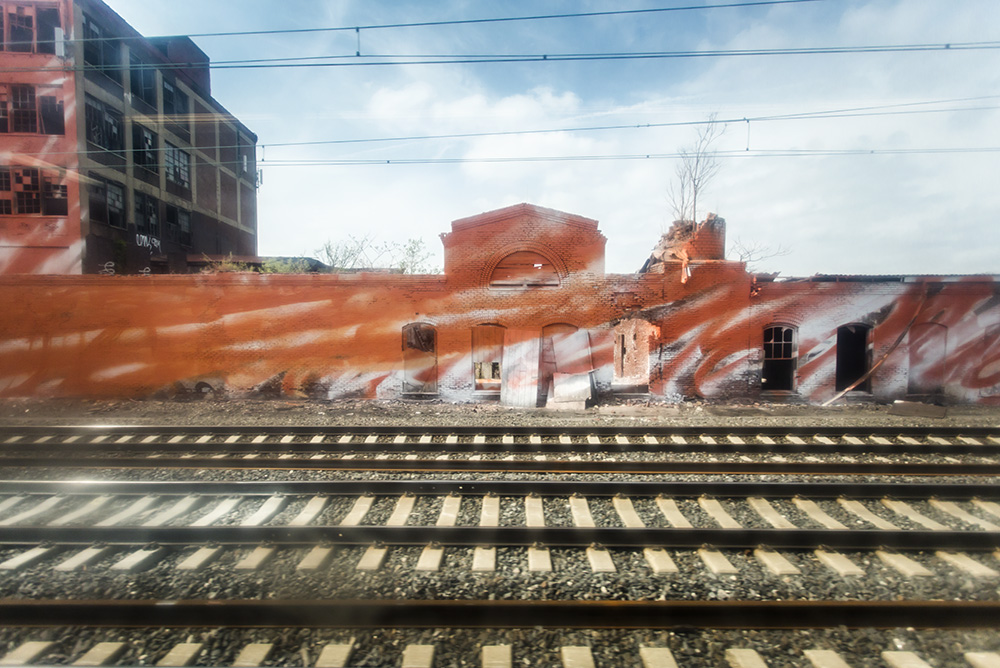
Now I had to deal with neon colors that were in fashion when I was an emerging tween in the late 80s/early 90s.
Disclaimer: I am not anti-graffiti by any stretch of the imagination. I can’t say I am a graffiti artist aficionado, and I typically notice this type of art in a fleeting manner – on a bike, train or car. Even when I enter abandoned buildings, I am often struck by the faded infrastructure of the building and certain tags or symbols. Usually graffiti artists know how to stay away from the public eye and create intricate type, landscapes and symbols.
A few weeks later, I learned that artist Katharina Grosse – she recently showed at MassMOCA – had a grant from The Philadelphia Mural Arts Program to create jarring landscapes to help us unwashed masses really look at the landscape we all ride by everyday. I immediately was insulted, and angered that someone had this answer to ‘helping’ people view their surroundings in a deeper manner. This was hardly a ‘beautiful disruption’ to my daily routine. It looked like some privileged artist got to dump paint in places she will never live or encounter besides her glorified paint project with her friends.
The exhibit, called Pyscholustre, is viewable via the SEPTA regional rail (Trenton and Chestnut Hill West lines) as well as The Atlantic City line and from Amtrak trains traveling from New York City/Philadelphia. This geography hits people coming in from points in the metropolitan area that range from quite affluent to extremely destitute. The transportation network this covers is quite expansive, networking major global metropolitan areas, weekend tourist arenas, sleepy suburbs and parts of Philadelphia that don’t come to mind for tourists eager to see Independence Hall.
This brilliance of light highlights areas of blight so the passerby can simply notice them. Is the hope to inspire entrepreneurs to tear down the factories and build condos? What lies behind the thin veneer of hyper color? Somehow I have a hard time believing that Philadelphia Mural Arts Program and the artist took a minute to get to know any of the people who inhabit the nearby space. The border may be an invitation, but how about you invite people who live in the city to capture and define those borders?
What also angers me is the people who produce graffiti along the same train lines – dare I say, people who aren’t white – face high risks of arrest and scorn for their cultural production. Why does Psycholustre get to be legitimate?
This comes at a time when Philadelphia’s ant-graffiti network via The City of Life, Liberty and You department begins aggressively regulating and tracking graffiti art. The department recently started using the ArcGIS application to document locations of graffiti. While it is easy to demonize the owners of private property in this instance, they do pay the brunt of expense for removing graffiti. It isn’t a wonder that city officials are listening to property tax paying citizens who don’t want to foot the bill for removing spray paint.
Sure, this is a gray area, especially if you are wary of property ownership. This app also targets graffiti artists who are doing their projects on the same industrial building where Grosse completes her work. Grosse and her well-protected comrades don’t have to worry about getting first, second and third degree misdemeanor charges or getting beat up by the cops in order to place paint onto buildings.
There is a certain dystopia that emerges in the once populated factories and dried out grass next to the train tracks. It doesn’t take more than riding a bike, or even driving a car, to see that people live amongst the abandoned buildings. With widening inequality emerging in late capitalism, certain property is deemed more worthy of routines of cleanliness, often brought to you by private contractors and taxpaying city services. Rarely does a person go to any of these buildings unless they want to admire the durability of the structures that still stand – and yes – the graffiti art.
Nor do I go to the extreme of David Lynch, who sees any graffiti as a defacement of the artistic structures of the industrial era. He too thinks that Katharina Grosse’s work is a ‘travesty’. In addition, he thinks any graffiti defaces properties and doesn’t draw anyone to understand the structure as it is. While many of these buildings are works of art given the craft that went into creating the brinks, steel and glass structures, these buildings are unoccupied and serve as a canvas to rework the city landscape. While I do think some graffiti can highlight the aesthetics of a structure, I also think it has the potential to help rethink landscape and structures that have remain abandoned for decades.
If the point of Psycholustre is to get an artist that is deemed legitimate by the art world to rethink space, then I consider it misguided. There are graffiti artists The Philadelphia Mural Arts could have consulted for a widescale project. How about the artists who create graffiti everyday? Don’t they know more about the space they reshape? Why is their art considered defacing, and Philadelphia Mural Arts approved work considered an exhibition? If Psycholustre is a mural, then I want the muralists who painted work far before her to come back and tag her mural.
 Connective Cube
Leave a comment