• Perhaps my last post displayed my distaste for people who assume that I am not paying any attention.  I think paying attention has some quite complex meanings in days of extreme economic insecurity.  As in, most people do not trust anyone around them, and it creeps slowly into social relations.

    Every city I have lived in reminds me of how far from home I really am.  No one was looking at me, or paying any attention to me, when I first moved to New York City as a transfer student. I wrote off cell phones at the turn of the century, hoping that fad would eventually pass.  Live journaling seemed to virtual.  I was never one to have a deep drive for a fine tuned community, and I didn’t particularly like to sit in front of a computer for time on end.

    Machines can’t control my senses!  I will move to the biggest machine of a city in the world!  Haha!

    So begs this project.  I am going to start jogging personal memories from every year of my life.  Unlike free market extremists, I do think that it is important to understand the past, to comb through the rubble and pick out the memories you can.

    Oh, and I mostly just want to track what music I was listening to at any given point of my life.

    0-4:

    Okay, well, I can say I do have a couple of memories from that era.

    These memories are not the same as watching the videos my parents shot of me on the camcorder.  I am glad they have memories for me to laugh at sometimes. Like the time I chased pigeons in Square in New Orleans.  Sometimes I will share those memories too.

    3-4:

    Some jerk with a mullet who entered the living room while I was obsessing over the jingle in Walk of Life.  He was Susan’s boyfriend.  While I was watching people walk, he picks the remote and changes the channel to some dumb show.

    I loved this ice cream dress.  Creamsicle, strawberry and grape all in fruit stripes with an ice cream cone in the center.  Mom made me take it off so she could wash it.  I was scared the ice cream dress would disappear.

    Mama’s Big Truck.

    …Next Story (Mamma’s Big Truck)

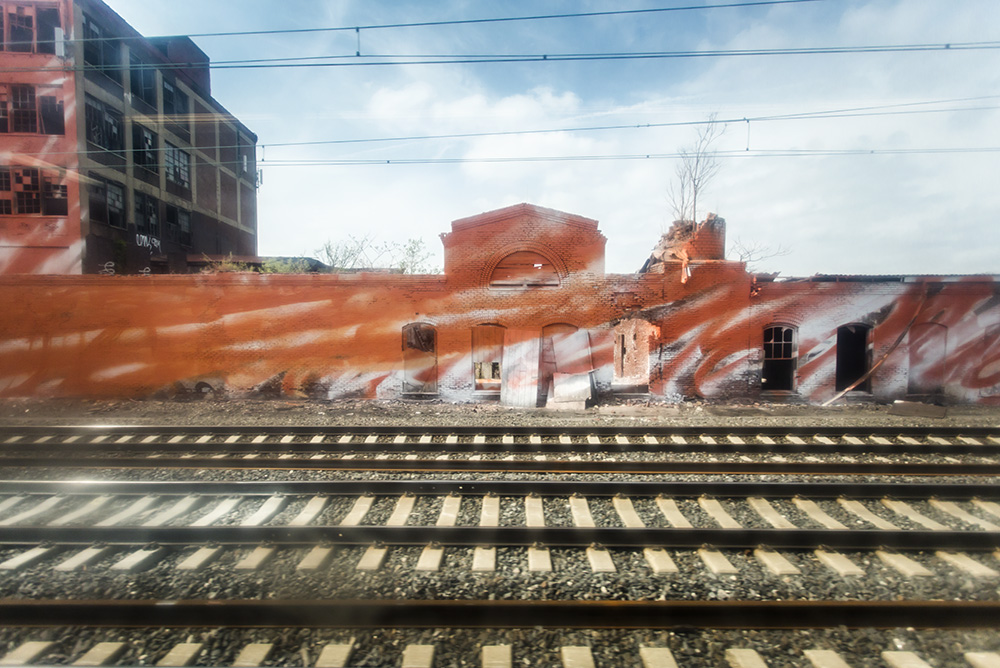
  • A few months ago on my ride to Center City on the Chestnut Hill West line, my ride became suddenly interrupted by splashes of hot pink, orange and green over grass, concrete and abandoned buildings.  Figuring this was additional graffiti by artists in the city, I mostly turned my nose up at the hideous clash with the landscape, and I wrote it off as a graffiti artist in Philadelphia with a large crew of helpers.  Most mornings I would spend mornings marveling at the bluish-green colors of the windows, the cracked brick, and the hints of grass that peek through my window of my morning commute. Now, I see creamsicle.
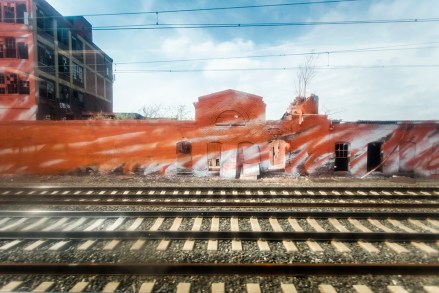
    psycholustre

    Now I had to deal with neon colors that were in fashion when I was an emerging tween in the late 80s/early 90s.

    Disclaimer: I am not anti-graffiti by any stretch of the imagination.  I can’t say I am a graffiti artist aficionado, and I typically notice this type of art in a fleeting manner – on a bike, train or car.  Even when I enter abandoned buildings, I am often struck by the faded infrastructure of the building and certain tags or symbols. Usually graffiti artists know how to stay away from the public eye and create intricate type, landscapes and symbols.

    A few weeks later, I learned that artist Katharina Grosse – she recently showed at MassMOCA – had a grant from The Philadelphia Mural Arts Program to create jarring landscapes to help us unwashed masses really look at the landscape we all ride by everyday.  I immediately was insulted, and angered that someone had this answer to ‘helping’ people view their surroundings in a deeper manner.  This was hardly a ‘beautiful disruption’ to my daily routine.  It looked like some privileged artist got to dump paint in places she will never live or encounter besides her glorified paint project with her friends.

    The exhibit, called Pyscholustre, is viewable via the SEPTA regional rail (Trenton and Chestnut Hill West lines) as well as The Atlantic City line and from Amtrak trains traveling from New York City/Philadelphia.  This geography hits people coming in from points in the metropolitan area that range from quite affluent to extremely destitute.  The transportation network this covers is quite expansive, networking major global metropolitan areas, weekend tourist arenas, sleepy suburbs and parts of Philadelphia that don’t come to mind for tourists eager to see Independence Hall.

    This brilliance of light highlights areas of blight so the passerby can simply notice them. Is the hope to inspire entrepreneurs to tear down the factories and build condos?  What lies behind the thin veneer of hyper color?  Somehow I have a hard time believing that Philadelphia Mural Arts Program and the artist took a minute to get to know any of the people who inhabit the nearby space.  The border may be an invitation, but how about you invite people who live in the city to capture and define those borders?

    What also angers me is the people who produce graffiti along the same train lines – dare I say, people who aren’t white – face high risks of arrest and scorn for their cultural production.  Why does Psycholustre get to be legitimate?

    This comes at a time when Philadelphia’s ant-graffiti network via The City of Life, Liberty and You department begins aggressively regulating and tracking graffiti art.  The department recently started using the ArcGIS application to document locations of graffiti.  While it is easy to demonize the owners of private property in this instance, they do pay the brunt of expense for removing graffiti. It isn’t a wonder that city officials are listening to property tax paying citizens who don’t want to foot the bill for removing spray paint.

    Sure, this is a gray area, especially if you are wary of property ownership.  This app also targets graffiti artists who are doing their projects on the same industrial building where Grosse completes her work.  Grosse and her well-protected comrades don’t have to worry about getting first, second and third degree misdemeanor charges or getting beat up by the cops in order to place paint onto buildings.

    There is a certain dystopia that emerges in the once populated factories and dried out grass next to the train tracks.  It doesn’t take more than riding a bike, or even driving a car, to see that people live amongst the abandoned buildings. With widening inequality emerging in late capitalism, certain property is deemed more worthy of routines of cleanliness, often brought to you by private contractors and taxpaying city services.  Rarely does a person go to any of these buildings unless they want to admire the durability of the structures that still stand – and yes – the graffiti art.

    Nor do I go to the extreme of David Lynch, who sees any graffiti as a defacement of the artistic structures of the industrial era.  He too thinks that Katharina Grosse’s work  is a ‘travesty’.  In addition, he thinks any graffiti defaces properties and doesn’t draw anyone to understand the structure as it is.  While many of these buildings are works of art given the craft that went into creating the brinks, steel and glass structures,  these buildings are unoccupied and serve as a canvas to rework the city landscape.  While I do think some graffiti can highlight the aesthetics of a structure, I also think it has the potential to help rethink landscape and structures that have remain abandoned for decades.

    If the point of Psycholustre is to get an artist that is deemed legitimate by the art world to rethink space, then I consider it misguided.  There are graffiti artists The Philadelphia Mural Arts could have consulted for a widescale project.  How about the artists who create graffiti everyday?  Don’t they know more about the space they reshape?  Why is their art considered defacing, and Philadelphia Mural Arts approved work considered an exhibition?  If Psycholustre is a mural, then I want the muralists who painted work far before her to come back and tag her mural.
  • Cassandra stands in a slow moving line for the alpine slide. She checks her phone, anxious about the battery running out in the next 20 minutes. Hopefully her sons will remember to meet her by the entrance of the slide.

    The line lurches forward. With the line and ride, Cassandra figures she has 20 minutes to get on the slide. How long would the ride last? Five minutes?

    Her sons wanted to ride on the alpine slide, a contraption so high that they have to take a ski lift up the brush covered mountain. Cassandra trusts a log on a pulley more than a free floating blanket on the slide.

    Her husband gets back from the convention in three hours. He oversees a large digital marketing department back home in Maryland. They finally could afford a vacation again, but they keep it cheap by having the hotel – and some airfare – covered. After all, they just paid off their credit card debts.

    Last time Cassandra took a painting class, she wondered if she would ever see true sienna. Varying hues of orange brown swept the landscape, and at many micro-seconds the harmony of the orange and green seem perfectly complementary. The expansive space and dramatically shifting rifts of a panoramic landscape made her feel ill at ease. Usually she is nestled within the trees, aware of the slight inclines. Panoramas like this typically exist within a 45-minute drive for Cassandra – always a destination rather than part of driving down the highway.

    What is brown’s compliment? Grey? Even the white has its black.

    Cassandra turns off her phone when she lifts the metal bar and sits on the thick plastic wood painted slide. The chair’s slight cushion is a welcome respite after standing for a half-hour. She eyes the log in front of her turning to the left over the bridge connecting one micro valley to the other. She takes out her phone, fumbles with the screen, and takes a picture of the sign ‘Entering the Ride – Please Fasten Your Seatbelts’ with the log in front of her and the end of the bridge in site.

    After the bridge, she someone whooshing quickly past her on the right. She takes a picture of the incline nestled between dry pine trees. The quiet of the background at times gets punctured by delightful squeals and gleeful screaming. Maybe she would get a motorcycle or replace her bike when she gets home so she can feel the breeze tangle and cool her head during quiet spring days.

    The apex turns sharply to the right and holds her for a moment. She clasps her giant lime green bag and grabs onto the handle bar with her phone underneath. The log lurches forward, slipping her grip. Her phone ricochets of the front of the log. Unable to lean forward far enough to grab it, the ride moves forward. Her phone falls back into the shallow entrance of the log.

    Cassandra feels her heartbeat increasing. Without her phone, she can’t contact her husband or children. What if she can’t find anyone? The boys can’t drive to the hotel. She lodges her foot to the right of the log, but it keeps slipping with the downward twists, turns and motion of the sienna tinged chocolate brown track. The phone clatters back and forth in the hard plastic cubby.

    A sharp right turn – the sharpest one yet – appears after a slow decline. Cassandra curls her toes and scoots it to the cubby. She clenches her thights and calves, determined, and annoyed that she didn’t put her phone in her bag.

    The bottom of the mountain is in sight, and she sees her children waiting at the entrance of the ride. The phone stays secure in the cubby. She takes a deep breath and closes her eyes for the slowing speed of the log. Maybe she would have a margarita tonight.

  • Does anyone who grew up with landlines and no cell phones sometimes feel like building a digital identity is a strange pursuit?  As much as I peripherally read fluff job seeking articles that tout building a personal brand is essential for surviving in this moment, to connecting with others, to getting a job, I can say that it just seems like a deeper connection with software design and the access to a wealthy lifestyle that lures people into policing their meta-self.

    Does this mean less of an awareness to surrounding conditions outside of the realm of the machines?

    I also feel like I don’t care to brand myself or become my own personal advertising agency with clear and consistent messaging.  I used to think social media was a way to stay connected with loved ones, but that so called love feels thin and way less satisfying than connecting with people in other ways.  This profile is just a shell of many of my experiences.  I feel like this shell is what people take seriously.  It is time to retreat, to escape this dread.

    Is my desire to shut down and turn off just an escape?

  • There is a major split in my life. As in, I never know when I am over sharing or not sharing enough. When I don’t share enough, I feel FMO – fear of missing out. When I do over share, I often want to lock myself into a room and not come out for days.

    With all of the emphasis on personal branding and maintaining an image online that is consistent with day to day life, I find that I am neither my online identity. Nor am I myself in the flesh without someone looking through my old photos. I used to liberally invite people into my social circle, and I even wondered if adding people I would only speak with one would be worth my brain space.

    Social media does take up my brain space, and it becomes more precious to me as I age. Why are pictures of my ex-partner’s sister’s children populating my brain space? This leads me to thinking about my ex – and we are on good terms – and wondering why I hop into relationships in general without thinking too much about mutual interests. which, in essence, is a rabbit hole. If I dates someone with all of my interests, then I would never be open to new experiences.

    And here is the thing. I notice that people hold you to what you say on social media. I see social media as platform that produces affect. Since people generally want to surround themselves by positivity, notes about how people are really doing – or hurting – gets swept to the wayside.

    Why aren’t those feelings allowed to be public? Sure, they can be as public as anyone would like for them to be. That is the thing – it is a choice. With increasing programs in positive psychology and a focus on tuning out anything challenging, the individual must rely on people in the flesh to grieve.

    Studies do show that the more negative emotionality posted on a site, the more likely people aren’t going to engage with the content. Instead of censoring emotionality, perhaps we can live in a society where people can have mixed feelings and be public about them.

    Within a traditional narrative, there is a story arc – the introduction, rising action, some sort of climax, and then closure and resolution. The social media story that I read about someone else is more nebulous than a narrative, and I also know that it is only a representation of presentation.

    Perhaps I have become less in representations of myself. Can I just see you in-person? Do I need to take photos when I see you? Can you forget about the noise that is the representation of myself? I know these questions just make me seem like an Eeyorish type who can’t accept the present, or the future for that matter. I would like to go home and not speak with anyone for the next two weeks.

  • My arms, my arms!

    Marcy exclaims as her trainer screams like a pitbull underwater in the distance.  Stopping won’t shut her up.  She doesn’t know that it is much easier to drink sweet tea on the porch.  There is a ball on my head, and all Marcy can do  is try to bend her arms slightly so the lactic acid won’t melt her muscles.  Why does lactic acid not burn muscles, nor any of the acids that flow through the body everyday?

    Whenever Marcy sat in Biology class in high school, she imagined that aerobic exercise would create a bubble hot milk that would melt the fat.  But where would the liquid sieve?  In pee?  Or would it be like peanut butter streaked through chocolate ice cream?

    That thought gets Marcy through three more pushes, and she has 20 to go.  The extra 15 pounds on each of her arms feel like they will collapse to the ground every time.  She wants to throw the weight in the air and collapse on the prickly green grass.  10 more to go.  Does she have to?  Again?

  • I cross my right leg over my left, over my right again.  That’s what the yoga instructor says.  Knowing that I must settle, I leave my legs open.

    Whenever I sit in front of someone new and talk, all I can imagine is a trickle of blood running down my nude stockings. 

    When I walk on the street, I still walk in the middle late at night.  I scuffle to the side when a car passes, and walk briskly by empty lots. 

    What if my bike chain breaks on the bridge balk to my house?  I don’t have anything on me but my ID and bank card with $2.00 on it until tomorrow at 4am. 

    I fold my legs into my chest when I watch movies to prevent falling asleep.  Sometimes I fall asleep hovering over my knees.  

  • mirror

    A visit to Salt Lake City wouldn’t be complete without a visit to Temple Square.  Is Salt Lake City the new Jerusalem? Will it become another Mecca where not just millions, but billions of people congregate on a bi-annual basis?  The answer to those questions fall outside the scope of this post.

    Instead, I will introduce the Conference Center.  To go inside the main temple, you must be Mormon and have permission.  Us other mere mortals can access the recently constructed Conference Center. My very Mormon 90-year old granddad wanted to take what may have been his last walk through the building.  It gave me an excuse to walk around without feeling overly blasphemous.

    We walk into the Conference Center and are immediately greeted by three women in skirts. Our host was probably no more than 20.  She said working at the conference center was part of her mission training.  Her enthusiasm for the scripture and the sites mystify me.  Lindsey is one of five sisters, and she keeps asking whether she can adopt my little brother.  Her little brother needs another man in the family, but she sure isn’t going to take mine.  After all, the younger ones are easier to convert.

    The actual conference center houses more than 21,000 seats.  This is where The Church of Jesus Christ of Latter Day Saints gather twice a year to celebrate.  What a spectacle!

    Image

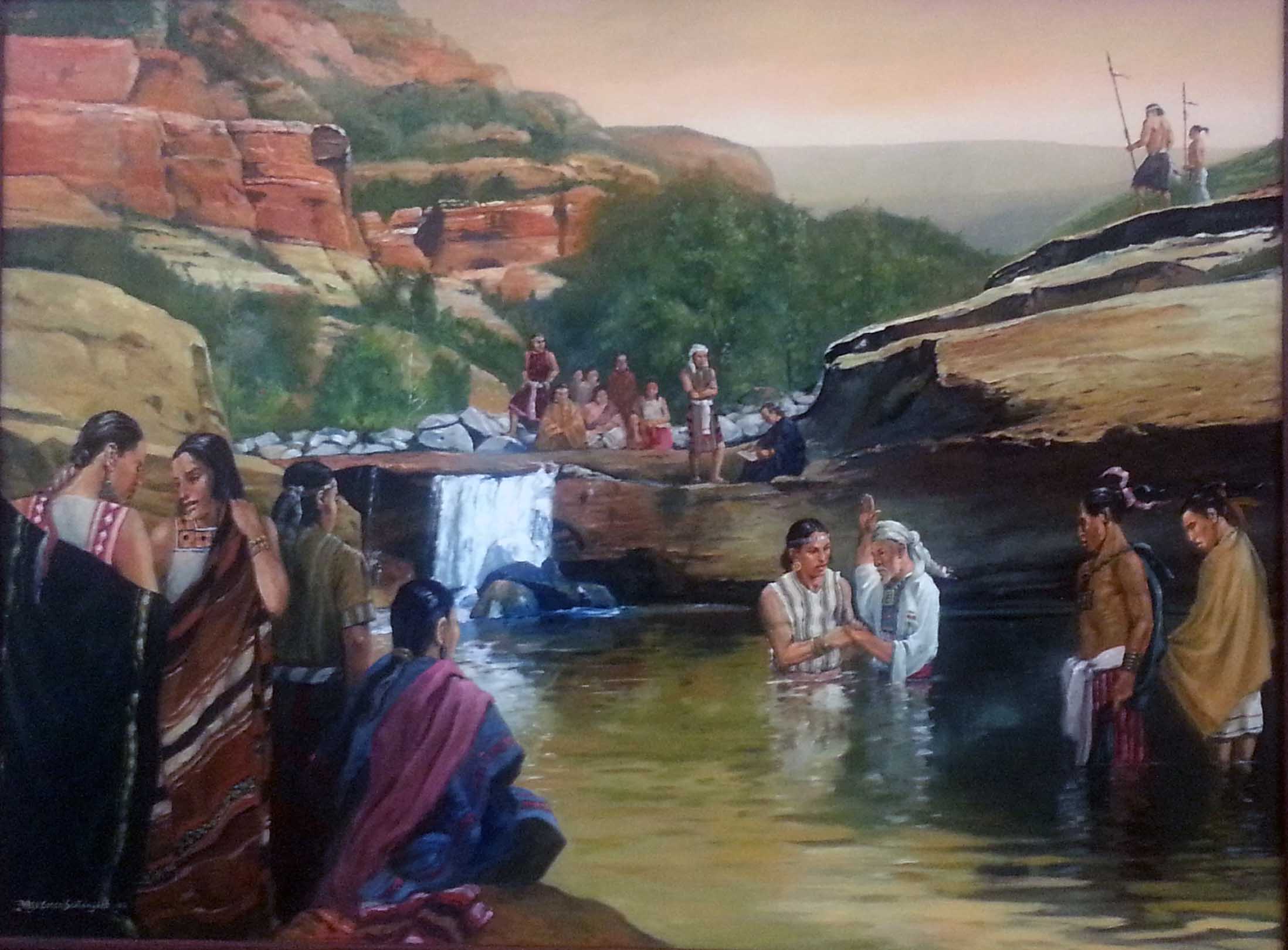
    Outside of the main arena is a small gallery of paintings depicting the story contained within the Book of Mormon. Many of the paintings within the conference center were constructed in the past 100 years, and the majority of them look like they belong in the Renaissance wing of a major museum. The paintings revise the dominant focus on Jesus while prominently featuring his figure in redeeming humanity.  Other paintings depict the emerging religion behind the landscapes of Utah buttes, mountains, rivers and streams.

    Image

    My lack of expertise in Mormon scripture begs this question as the tour unfolds: How did Jesus communicate with the prophets of this new religion? After touring many churches in Upstate New York, Adam Smith became upset about the lack of consistently in interpreting The Bible.  Adam Smith saw God and his son Jesus in the woods, and they told him he would be the new prophet to spread the truth of Jesus’ word.  What God – commonly known as Heavenly Father – and Jesus said to Adam Smith is transcribed on golden plates that are buried somewhere.  It would be amazing to see people with beach comblng equipment scouring the mountains for these plates.

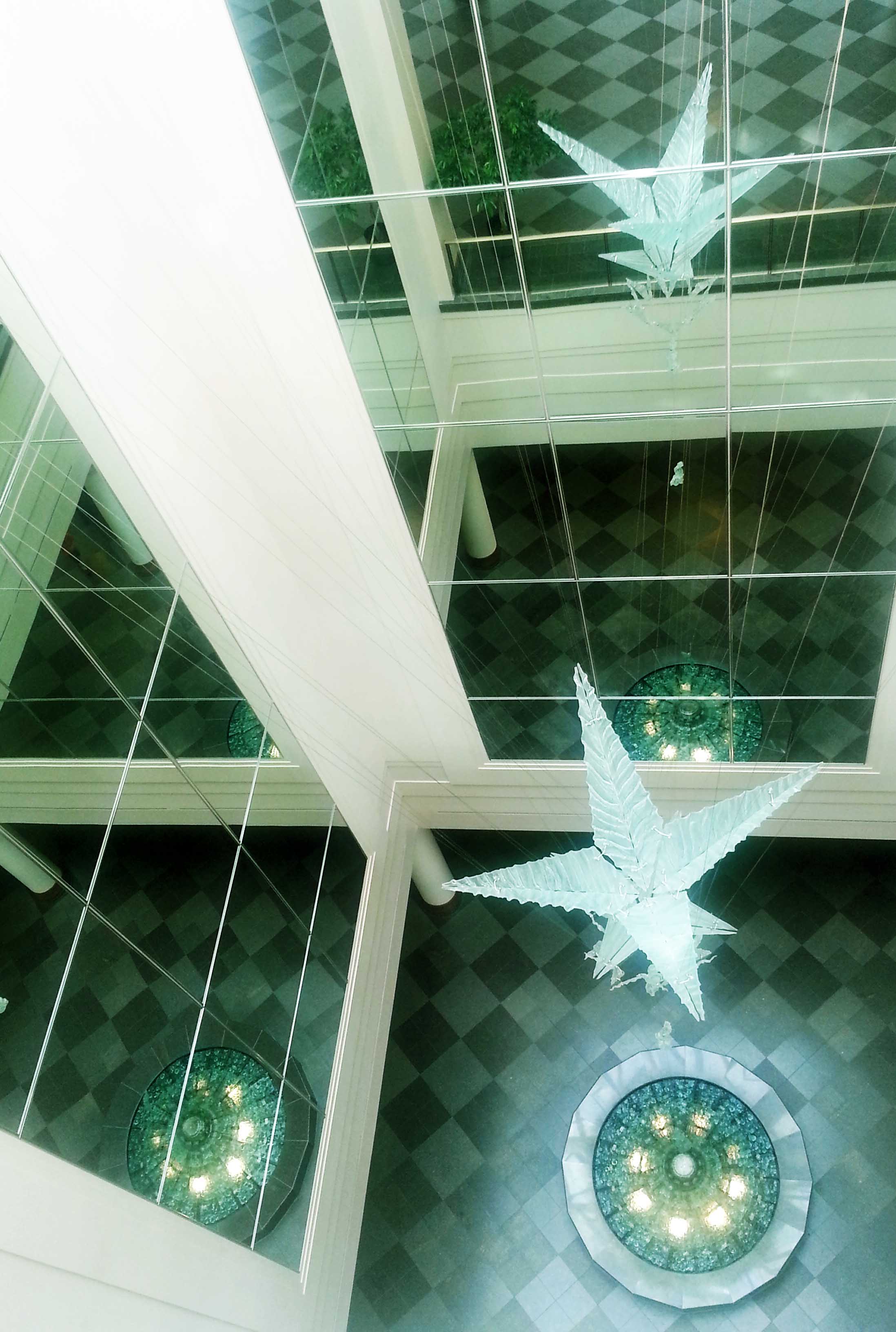
    Perhaps the tackiest yet strangely satisfying part of the tour is looking at the green iridescent star structure on the first floor and then again on the third floor.

    conference center star

    The final room was statues of all the Presidents as well as portraits of the main apostles of the Church.  There is nothing important to mention except the multitude of white and male faces.  The portraits feature all of the men in the standard suit and tie, stalwart images of pure American leadership.  I was relieved to enter the elevator.

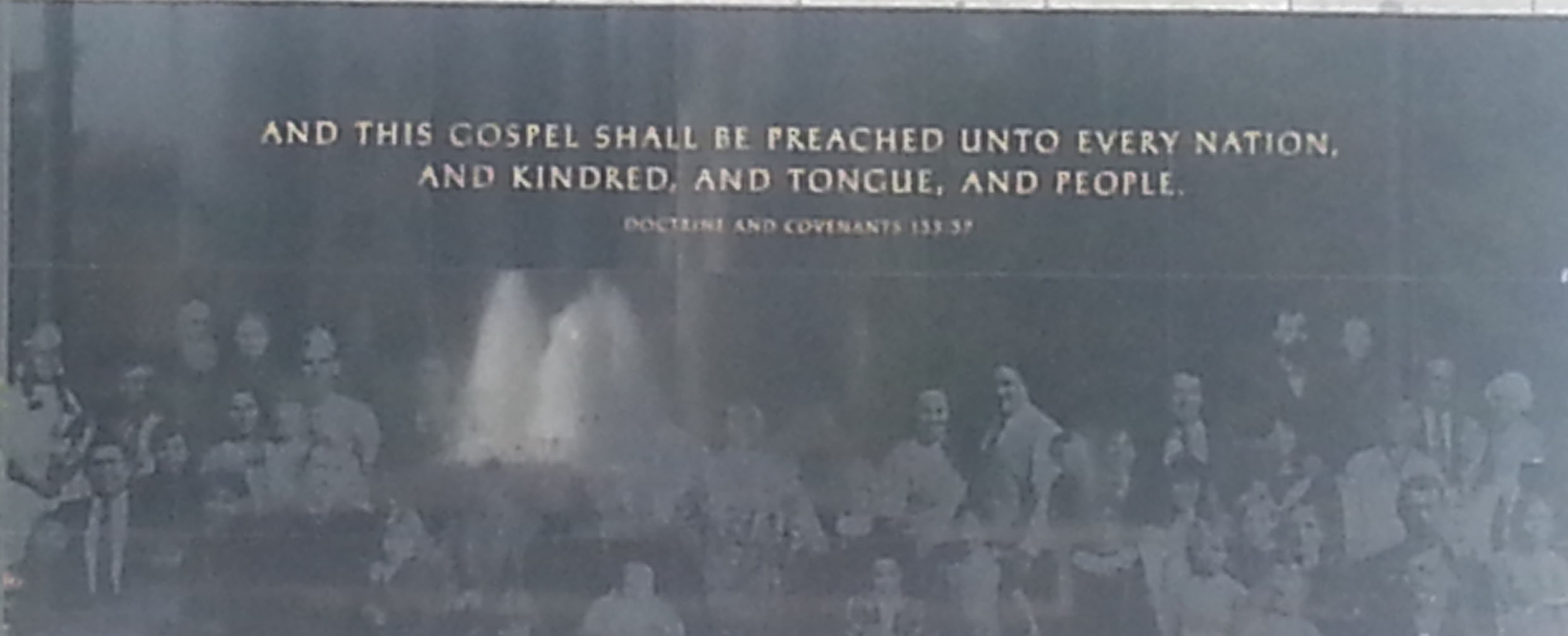
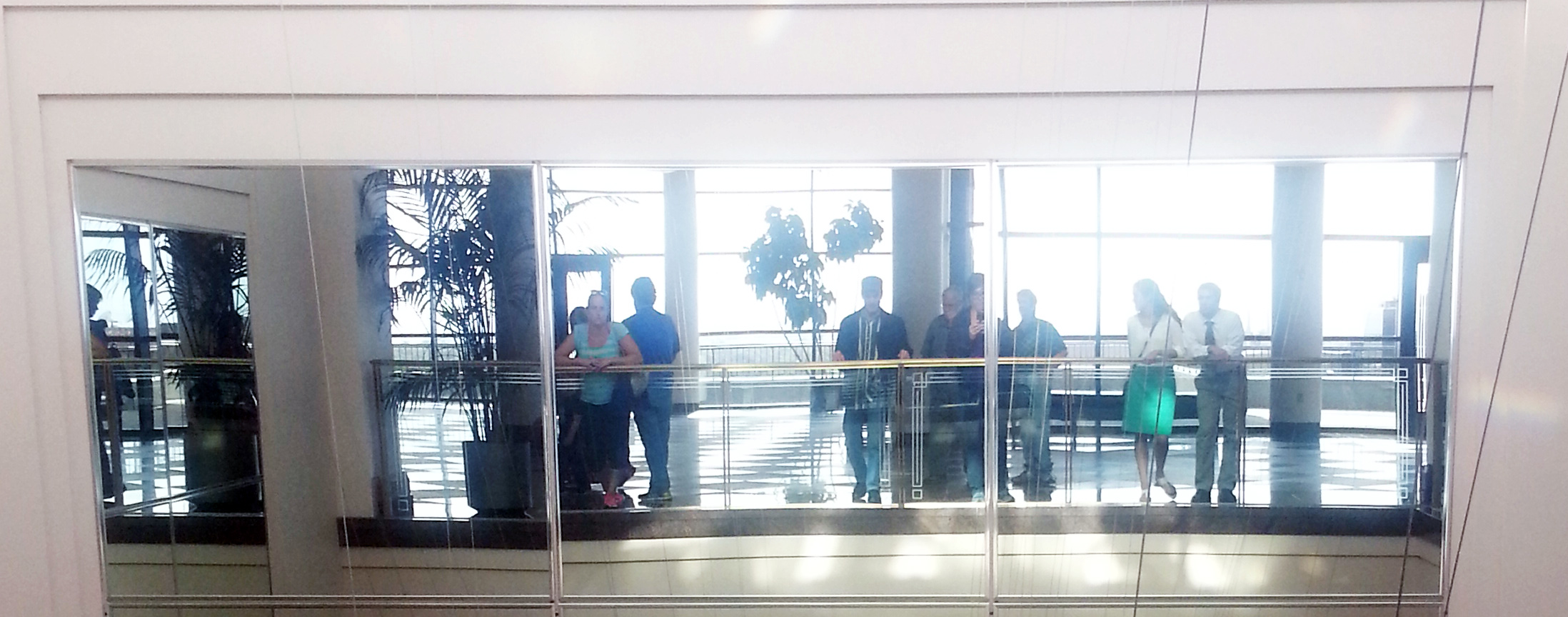
    At the end of the tour, we go to the top of the conference center.  A large granite image greets us at the end of the tour.  If you get close enough, you are supposed to see your image among all of the other faces of the Mormon religion.  I elected not to take a picture with my face among the many other faces.

    Image
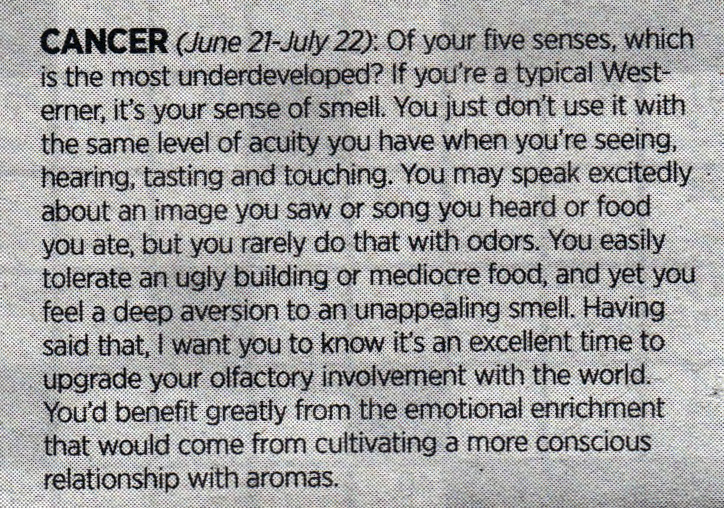
  • I found this after I posted the 9/11 blog entry about remembering the smell.  It was in an old Creative Loafing my roommate had sitting around.

    cancer

  • Top WTC

    Ten years ago, I woke up to a phone call from my Dad’s girlfriend in my dorm room on Lafayette Street.  It was early in the morning.  Did someone die?  My class that day didn’t start until around noon, and I had not planned on waking up until nine.  She told me a plane hit the World Trade Center.   The same World Trade Center I had gazed up at when I went grocery shopping on Greenwich Street.

    I had wanted to make pasta sometime that week and get used to cooking.  I had just moved to New York from the outer suburbs of Atlanta.  At the time, terrorism was something that happened somewhere else to an Other, something that happened in lands that I read about in the copies of The New York Times I would buy on campus at The University of Georgia in Athens, where I had attended college for my first year and had experienced an overwhelming support on campus for the election of George W. Bush.

    This memory of rolling out of bed sticks with me, even years later when I watch footage of the planes hitting the buildings.   I was ever so naïve then, turning on my roommates’ 12” inch television and staring into the screen, moments after the second plane had hit.  At the time, it didn’t occur to me that a terrorist attack had happened.  I hadn’t thought deeply about terrorism or the end of the world at the time.  Only days before I was asking my roommates, who were from San Francisco, who the man with a mustache surrounded by red was on their wall.   They rolled their eyes at me.

    I decided to grab a bagel.  It was really my excuse to walk over two avenues to Church Street, where I would get a full view of the towers.  I arrived.  It was the first time in my life that I felt completely disconnected from my body.  I knew I was missing some major piece of the puzzle as to why this happened.   I didn’t see the building collapse, but I did see the planes lodged into the buildings.   Little black specks dotted the landscape.  At the time I thought it was ash, but then I realized later it was dead bodies falling to the ground.  The people all around me had their mouth agape, looking up.  We were far enough away so the debris wasn’t falling around us, but I was close enough to realize that I needed to get back to my new home and call my not-so-old home.

    When I got back to my dorm, I tried to call my mom and tell her that I was okay.  While I was on the phone with her, a security guard came and told us we would have to evacuate our building.  I didn’t realize that my thong underwear and platform heel shoes would irritate me on the walk uptown.  When I got downstairs – I lived on the second floor – my roommates from San Francisco, with looks of terror on their faces, asked me to go back upstairs and get their purses.  They weren’t letting anyone who had crossed the front desk back into the building.  After I grabbed their purses, we walked outside.  The dust and remains of the collapse of the twin towers reached the street two blocks south.

    What happened right after we were evacuated from our building, which was only blocks south of Canal Street, remains blurry.   Everyone walked uptown, and I tagged along with my three roommates.  I was still anxious about whether they liked me or not, even on this long walk uptown.  Was I ever so young, as young as Didion’s shivering image of her past.  We got to the campus at NYU, and we were told there were cots at Coles Gymnasium.  I opted to go to Carlyle Court with my roommate from New Mexico.  We watched images of the planes hitting the towers on television. About the 10th time we saw the image, I started bursting into tears and regretting my move to New York.  I would stay for an additional nine years.

    ***

    The next day I woke up before everyone else in the room and left Carlyle Court to find underwear.  In my young age, I forgot to leave a note, and I apparently terrified everyone with my disappearance.  In my young age, I thought they didn’t want a sobbing wreck to deal with.  I went to K-Mart on Astor Square to find underwear, and perhaps a more comfortable pair of shoes.  The streets were silent on Wednesday morning.  No one was humming into work, and plenty of people were sleeping in.  I got to K-Mart, and there was no underwear, no socks.  So I got a pair of flip-flops and walked to Washington Square Park.  I ran into a girl from transfer student orientation on the 9/12 streets, called my mother, and rode up to Dykeman Street with my friend from orientation to stay with my second cousin.  It felt like another world, and I didn’t want to hop back on the A Train and go back home.  When I did, I had to show my ID to get through a security checkpoint, something I would have to do for the next couple months.

    ***

    By next Tuesday classes had resumed.  I was taking an upper level Sociological Theory course, one I would not be able to concentrate on for the remainder of the semester.  The professor, a Durkheimian scholar, asked us what we thought about the increasing displays of nationalism at the memorials in Washington Square Park and on television.  I felt frozen.  I really had no idea how to answer that question.

    ***

    Telling people this story, recounting this story at times almost seems pointless, as if I am reveling in some congratulatory effort for having been near the towers that day.   This is not the case.  I was jealous of the people who watched it on television.  In my moments of post-traumatic stress disorder, I told myself I had no reason to really feel sad.  No one I knew died, and who really cares if I didn’t know what to do once the buildings fell?

    Within all of this I knew in my gut that I shared this world orders benefits, and perhaps that I was responsible for this attack in away as an American citizen.  But I ignored this question, sinking into a deep depression for a few years that continued my invisible streak I desired to leave behind in Georgia.  This continued to shut me up from pointing out how inevitable an event like 9/11 was.  I didn’t want to become a terrorist either, proclaiming that it was this nation that needed to get back at the terrorists.  It confused me.  If we got back at the terrorists, then weren’t we terrorists too?  Weren’t the terrorists getting back at us?  I didn’t want to be a terrorist, but it got to the point where I didn’t want to be silent forever either.

    Maybe this desire to not engage with why 9/11 happened came from this sense of guilt that I felt when I looked at the buildings with the two planes lodged into them.  I had no idea they would collapse.  I just thought there would be gaping holes in the buildings for a really long time. The floors below the holes would be used, and everything above would be a memorial that people could fly through in the years to come.  So I thought.

    Months after the terrorist attacks, Jean Baudrillard wrote “The Spirit of Terrorism,” which pointed out the potential for an extreme nationalism to emerge.  He makes the point that the good/evil dichotomy related to a Westernized way of thinking, one where one way is automatically ‘right’ and the other way ‘primitive,’  The media plays an important role in this emergence, as it repeats the image of the attack, and keeps the memory of the attack relevant.  The difference between the time Baudrillard was writing and now is the emergence of digital media, of viral media that spread images and messages around to even more fragmented groups of people.  Al Gore did not have a Twitter page.  There were no smart phones clicking images of 9/11 and posting them on Youtube, and no comments from people who saw the experience first hand.  This experience came from documentaries, from news sources.

    Yet the United States is not Germany geographically.  It is enormous, yet the sense of personal responsibility prevails in terms of formations of citizenship.

    One point Baudrillard makes remains relevant to the present moment, and perhaps relates to how  globalization is threatening the nationalism that people cling to.  “We are even facing, with the World Trade Center & New York hits, the absolute event, the “mother” of events, the pure event which is the essence of all the events that never happened.”  I guess it amazes me to this day how quickly people have moved on from this event, while I can’t forget the acrid smell of dead bodies and metal that permeated the air for months.  The televisual does leave out certain sensory experiences.

    One question I often ask, perhaps foolishly in response to Baudrillard, is how digital technology has rendered this event not as a moment of spectacle, but rather as a symptom of a system that was infected a long time ago.  Baudrillard would agree that the system was infected long ago, and he even debunks his own theorizing of the simulacra temporarily.   But the image of the towers remains alive, and depending on your news feed, you may or may not be hammered with sombre messages about 9/11 in 2011.  Yet his postmodern thesis that there is no originality to a commodified image remains in question in “The Spirit of Terrorism,” at least to me.  The twin towers went up in the race to claim the ultimate city, and at one point the twin towers were the largest twin stuctures in the world in the ultimate city.  Yet this image of the ultimate city was destroyed in a moment, at a time when many parts of Manhattan didn’t quite resemble a suburban shopping mall.  One, then the other, fell.   The city needed to recover by proving it was strong, by proving it could persevere.

    Part of this perseverance, to me, was forgetting what happened, and quickly on a mass level.  This was especially evident when I was sitting in my Broadcast Journalism class one year later.  If the media perpetuates all evil, as Baudrillard says, then I knew I wanted no part of it when our teacher showed us the planes hitting the towers and asked us to write a news story about it in Fall 2002.  This wasn’t a free write whatever you want and get your emotions or arguments out; rather, it was a practice exercise to write shortened copy about the event that would appear on CNN, CBS or some other news channel.  I felt the room, sobbing, feeling like such an idiot for feeling anything about it.  Everyone else around me had seemed to move on so quickly, and if they hadn’t, they saved the sobbing for the safe confines of their apartments.

    The schism in the NYU Journalism School was whether to teach people how to become engaging writers or whether to teach people to write for network news or major newspapers.  It was kind of shocking that a major journalism school in New York City was caught up in such an irrelevant debate.  They obviously thought the technology bubble had burst and had no way of reforming at the time.

    If moving on means that I have ejected any memory of the day and months following 9/11, I still haven’t moved on.  Perhaps that thought came from my own terrorism of navigating a subway system nine years later that I felt terrified to ride on an even more heightened level than I felt only five years earlier.  I didn’t bike because it was the new cool thing to do amongst people my age, but because I didn’t want to be on the subway when a suicide bomber attacked.  Seriously, what if a suicide bomber blew up the subway?  The London attacks happened on my birthday, which is more a coincidence than anything else, but something that adds a link I have not become quite so comfortable with.

    ***

    Sure, I can’t live in that fear, but it’s funny what that memory of the smell, the checkpoints, and the utter silence of New York City for that few week period can emerge in memory.  Perhaps it was the first time I really thought about life and death, the first time I realized how fragile the system around me really is.   That is, the system of deep urbanization that we have all deeply naturalized. And I know this weekend people my age will whip out their iPhones and Smartphones and record the beams of light that shoot through the sky every year.

    I wish they would stop.

    I had no idea this could ever happen when I moved to New York.  I sometimes get scared at how comfortable the present moment feels, as if no one worries that this could happen again.  This is not a call to live in fear, but rather a call to engage in dialogue that extends beyond what I am finding a deeply move inward to form communes where you only include people who agree with you.  I moved to New York to live away from this communalism, largely based in the Church, yet I find these present communal formations emerge from a fear of excessive isolation.

    There were no phones recording this event and posting it on youtube moments later.  There was a struggle to document the moment, to piece it together, and to situate it into some understanding of the horror of that day.   But perhaps the linear narrative is no longer the moment.  The time/space compression in New York City speeds up as people become more connected with their loved ones through digital technology, but I have become suspicious of this connection over the years.  This is not because I don’t feel more connected with people because of this technology – I do – but I also think it provides a layer of protection from the terrorism that happens so sharply in front of our faces everyday in the name of reproducing capitalism.   Is it an effort to disconnect with terrorism by utilizing media to form social connections and bonds that were more difficult to enact in more traditional forms of geography?  For those with terrible social skills like myself, this may be the case.

    So why did this happen?  Is this a fourth world war?  I don’t think so, at least in the exact way that Baudrillard theorized.  The towers collapsed, the Pentagon had a big gaping hole, and the site in Pennsylvania is a rural blip on the map to many.  The wars continued well after 9/11, the hunts for weapons of mass destruction, the mass killings of innocent civilians that we don’t hear about.  This technology of the past was supposed to improve the lot for humanity, with little thought about how it would destroy humanity.  But humanity continues to self-destroy if robots are being made to do warcraft, if who gets to die relies on this struggle to own the majority of the world’s capital and commodities.

    I do think the thing to fear in this country in the years to come is a return to communalism that is encouraged by the fragmentation of social media.  This continues to separate humans from the corporate powers that continue to produce technologies and alter what it ultimately means to be human as we know it.  I don’t embrace this change fully.    I do desire to be touched by people who can engage a sensory processes that I feel is not precisely human as the way we knew it ten years ago.  Heck, this essay would likely ended up in one of my dog-eared diaries.  But I don’t lament what used to be.  It was awful.  I want something else, but will that come with the development of socialized technology and globalized conversation?  Maybe my teeth will rot before I can fully answer this question.  Or maybe I will die of some scary cancer that grew from the air I breathed in months after 9/11.

    Now another architectural wonder will symbolize New York City’s perseverance.  I’m glad I am not there to witness it.